
Hearing Augmentation Systems
Accessibility Compliance, Without Compromise
Auracast-Enabled Accessibility Systems
Recent accessibility mandates require hearing augmentation systems in commercial AV fit-outs. Auracast delivers compliance without compromising on quality.
Walk into almost any office, government building, or public venue completed in the last few years, and an access consultant will already have been through it to help ensure a person’s experience of a space doesn’t depend on their physical ability to navigate it.
Hearing augmentation has always been considered important, but recently it has been more strickly enforced. Under Australia’s disability discrimination legislation, hearing-impaired people are entitled to the same experience as anyone else in a public or commercial space, not a lesser version of it. That obligation now shows up in fit-out specifications for government offices, corporate buildings, and public venues as a AV project requirement.
Why Choose Our Hearing Augmentation Systems?
Most briefs we receive for hearing augmentation arrive with the same instruction: give us the cheapest compliant option. But a great system does not have to be an expensive system. Auracast, the broadcast audio capability built into the latest Bluetooth Low Energy specification, lets us deliver superior accessibility, with none of the trade-offs older induction loop, RF or infrared systems force you to accept.
Digital, Interference-Free Audio
Genuine Broadcast Privacy
No Separate Receiver Needed
Scales From One Room to a Precinct
Built In From the Design Stage
Integrated With Your Existing AV
Accessibility System Specialists
Our Approach to Hearing Augmentation
Before any hardware gets specified, we work through the brief with your access consultant to understand which rooms genuinely need a dedicated, permanently installed system versus a shared portable unit that can move between smaller spaces, and what capacity each room needs to cater for.
Induction loops are vulnerable to interference from steel structure and adjacent rooms. RF systems broadcast like a small FM station, with no real privacy. Infrared trades that privacy problem for a soft, static-laden signal. Auracast, built into Bluetooth 5.2 and above, is a genuine one-to-many digital broadcast protocol that avoids all three trade-offs.
A room fitted with an Auracast transmitter broadcasts directly to a modern Auracast-enabled hearing aid, no separate receiver, no pairing process. For anyone with an older telecoil hearing aid, or no compatible device at all, we supply dedicated receivers with neck loops and headphones, such as the Auri system from Listen Technologies and Ampetronic, purpose-built.
For larger venues, a single transmitter can sit on the building network with subsidiary transmitters daisy-chained off it, letting coverage expand across any floor plan without losing digital encryption or audio quality. Compare that to the labour cost of running loop cable through a large venue, and the total cost of ownership tells a very different story to the sticker price of the receivers alone.
Andre van Stom - Sound with Vision Founder
“A compliant hearing augmentation system (and a genuinely good one) can cost the same to install. The difference is in the design process, understanding which spaces need what, and specifying hardware that doesn't force a trade-off between meeting the legislation and delivering an experience worth having.”
Considerations for Hearing Augmentation
Room Type & Use
Expected Capacity
Legacy Telecoil Users
Network Architecture
Existing AV Integration
Portable vs Permanent
Hearing Augmentation Specialists
In Practice
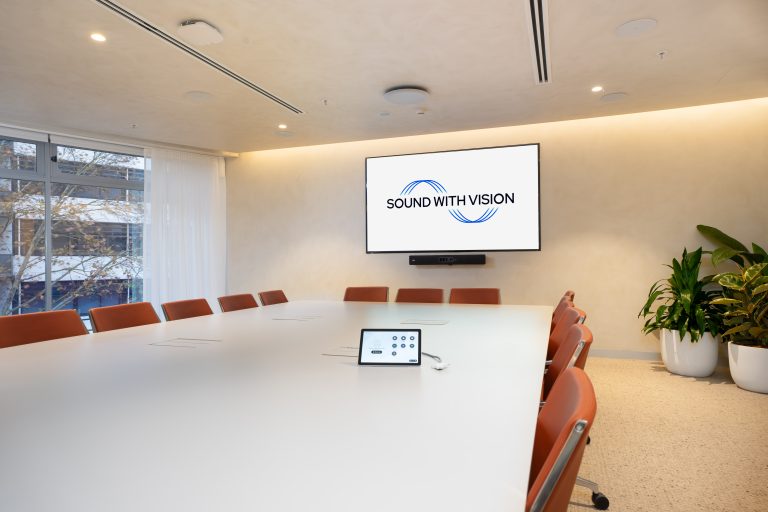
We recently completed a training room fit-out with Auracast built into the room’s core AV design from the outset, rather than treated as an add-on once the rest of the specification was locked in. The result is a space where a hearing-impaired participant has the same access to the session as everyone else in the room, no separate device to collect at the door, no compromise on audio quality, and no risk of the broadcast bleeding into the room next door.
That’s the distinction that matters. A compliant hearing augmentation system and a genuinely good one can cost the same to install.